

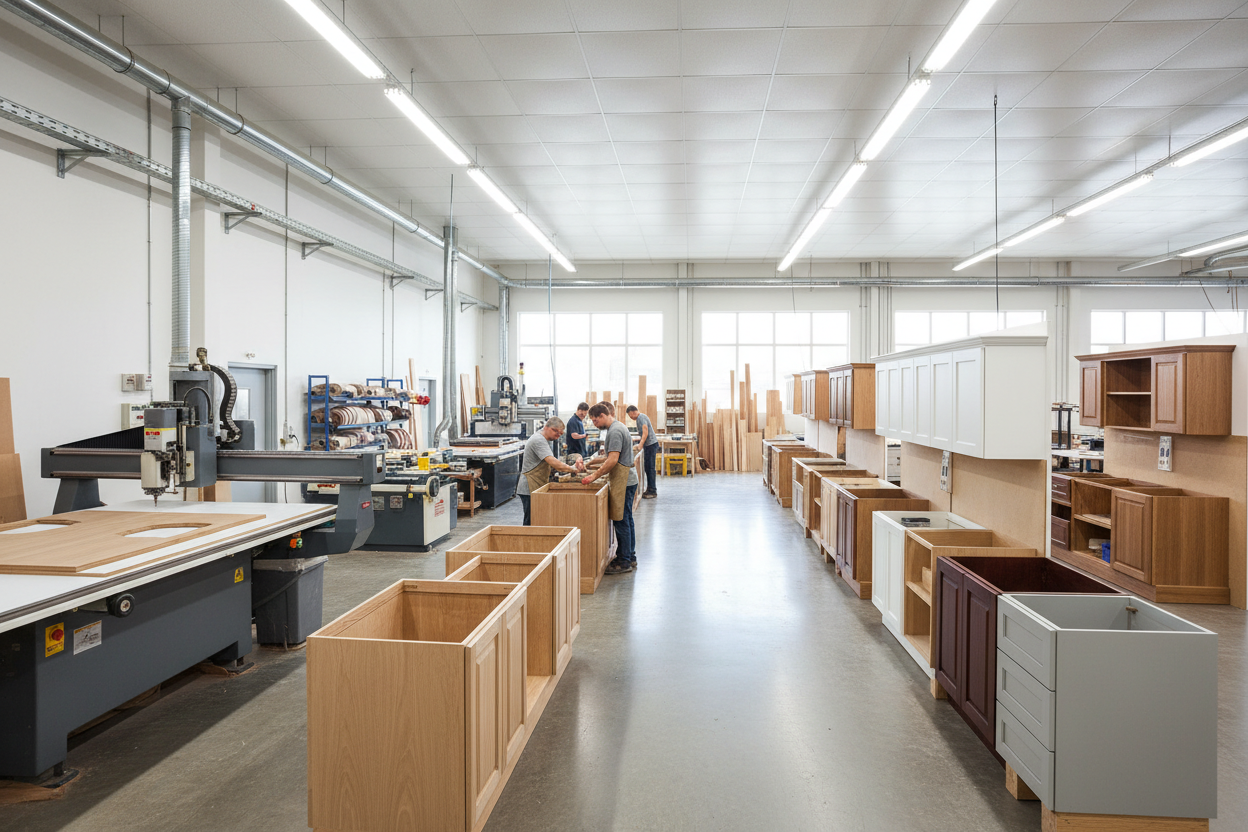
For developers, contractors, and wholesale buyers, choosing the right cabinet companies is a strategic decision that directly affects cost control, delivery timelines, and project quality.
Unlike residential buyers, B2B clients must assess cabinet suppliers through a structured evaluation process focused on scalability, repeatability, and risk management.

Why B2B Selection Criteria Are Different
B2B projects typically involve multiple units, standardized specifications, and strict deadlines. This requires cabinet companies to deliver consistent results across large volumes.
As a result, emotional design preferences are secondary to operational reliability.
Production Capacity as the First Screening Factor
The initial step in evaluating cabinet companies is verifying production capacity. Suppliers must demonstrate the ability to handle projected volumes without compromising quality.
Key indicators include:
- Number and size of manufacturing facilities
- Monthly or annual production output
- Equipment automation level
- Workforce stability and technical staffing
Standardization and Repeatability
For contract projects, cabinets must be identical across units. Variations in finish, dimension, or hardware can cause costly installation issues.
Professional cabinet manufacturers rely on standardized production systems supported by digital design and manufacturing integration.
What Repeatability Ensures
- Uniform appearance across all units
- Smooth installation workflows
- Reduced rework and warranty claims
- Predictable project outcomes
Customization Systems for Project Efficiency
B2B buyers increasingly require custom cabinet companies that can adapt layouts while maintaining standardized components.
Advanced cabinet companies use modular frameworks that support:
- Multiple unit layouts within one project
- Flexible cabinet dimensions
- Consistent door styles and finishes
- Interchangeable internal structures
This balance between customization and standardization is essential for efficiency.
Quality Control and Inspection Protocols
Reliable cabinet companies implement quality checks at every production stage. B2B buyers should request documentation of inspection processes.
Common quality control stages include:
- Raw material inspection
- Panel cutting and edge banding checks
- Assembly verification
- Surface finish inspection
- Final packaging review
Delivery Reliability and Timeline Management
Delays in cabinet delivery can disrupt entire project schedules. Experienced kitchen cabinet suppliers provide clear production timelines and buffer capacity.
B2B buyers often evaluate:
- Historical on-time delivery performance
- Production scheduling systems
- Contingency planning during peak seasons

Export and Logistics Capabilities
For international projects, cabinet companies must manage export packaging, container optimization, and shipping coordination.
Suppliers with global project experience reduce logistical risk and administrative burden.
Technical Support and Documentation
B2B projects require clear installation guidance and technical documentation. Leading cabinet companies provide:
- Detailed shop drawings
- Installation manuals
- Hardware specifications
- After-sales technical support
This support minimizes installation errors and accelerates project execution.
Risk Management and Long-Term Stability
B2B buyers prioritize cabinet companies with long-term operational stability. Factors such as financial health, factory ownership, and workforce continuity influence supplier risk profiles.
Stable cabinet companies support repeat business and multi-phase projects.
Why Price Alone Is Not a Reliable Indicator
While cost matters, selecting cabinet companies based solely on price often leads to hidden risks, including inconsistent quality and delayed delivery.
Experienced buyers evaluate total project cost, including risk mitigation and long-term performance.
Conclusion: A Structured Approach to Selecting Cabinet Companies
For B2B buyers, choosing the right cabinet companies requires a structured evaluation focused on capacity, systems, and reliability.
By prioritizing manufacturing strength, standardized processes, and project experience, buyers can secure cabinet partners capable of delivering consistent results across large-scale and contract projects.


